
MLOps
A model trained by hand is hard to retrain, compare or roll back. We make every version traceable, repeatable and monitored in production, under the same access, logging and security requirements as your other services.
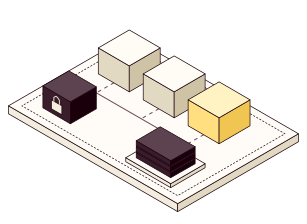
From experiment to production
Every version should trace back to its data, train again without a notebook, and be watched once it runs. We build that with the tools you have, or ones we choose together.
- Traceable versionsEvery model traces back to the dataset version, code and parameters it was trained with, and a model registry shows where each version runs today.
- Repeatable training and evaluationPipelines train and evaluate the same way every time, on your test data and within your GPU quotas, and register a new version only once it meets the requirements.
- Controlled deployment and monitoringA new version replaces the old one in a controlled way and can be rolled back. Quality and changes in the input data are tracked over time, with alerts when quality drops.
The same requirements as other services
The model connects to your existing systems under the same access, logging and security requirements as any other service.
- AccessWho may train, deploy and call models, with the same identities and roles as your other systems.
- LoggingRequests, versions and deployments are logged where your other logs live, with alerts going to the same place.
- SecurityNetworks, secrets and dependencies are handled as in your other services.
- Existing systemsThe systems that use the model call it through a versioned API.
- Other services
- The modelOne service among the others.
- LoggingThe same logs and alerts as your other systems.
- Access
- SecurityThe same networks, rules and secrets.
From discovery to monitoring
We start with how models are trained and deployed today and build a first pipeline for one model. It becomes the template for the next.
- DiscoveryHow models and data are versioned today How training and evaluation work How models are deployed and monitored Result The current state and where we start
- PipelineVersioned data and models Training and evaluation in a pipeline Requirements a new version must meet Result A first pipeline for one model
- DeploymentFrom registry to production The same access, logging and security as other services Rollback to the previous version Result New versions in production through the pipeline
- MonitoringQuality over time Alerts when quality drops Input for the next training run Result A model that's monitored in production
Around the pipeline
- The training platformGPUs, quotas, datasets and checkpoints for the training jobs.
- The model as a serviceRuntime, queues and a versioned API, measured on latency and cost.
- Cheaper to runAn optimized model is a new version, evaluated against the same requirements.
AI tools in our own work
We also use AI tools in our daily work: to get up to speed on a codebase, search logs, and draft tests and configuration. The output is reviewed and tested like any other code.
You can run the workflow yourselves
The pipelines, registry and runbooks are yours, so your team can train, evaluate and deploy the next version the same way.
- Train and register a new model version through the pipeline
- Deploy the version and roll back to the previous one
- Monitor quality and catch a degradation
- Pipelines as codeTraining, evaluation and deployment in your repository.
- Model registryVersions with their data, code and evaluation, and which one runs where.
- Requirements for new versionsThe test data and thresholds a new version must meet.
- RunbooksDeployment, rollback to the previous version and troubleshooting.
- Access and ownersAccounts and keys stay with you, with a named owner for each part.